



.png) Carly Christian
Carly Christian
|
AI isn't failing because the output is bad. It's failing because teams skip the strategy work that used to happen before execution and the verification that used to happen after it. These aren't AI problems. They're strategy gaps that stayed hidden while execution was slow, and now they scale. |
When we audited one of our industrial clients, we found 39 of their pages showing up in Google for the searches we track. 37 of them were competing with each other.
Search for their company and the services they offer, and nine of their own pages came up. The best one was on page four of Google, and it had dropped 29 spots in a single week. On a product search that gets 210 searches a month, four of their pages were splitting the results.
Nothing was wrong with the writing. Nobody had decided which page should own which search, and publishing was easy enough that nobody stopped to ask.
That's the shape of almost every AI problem we're fixing right now. The output is fine. The decisions around it never got made.
Below are the ten we see most, what each turns into, and what to do instead.

1. Content that's technically correct and strategically wrong
AI writes exactly what you asked for. It doesn't know the business goal, the audience, or where the asset fits. You get 1,200 competent words targeting a phrase no prospect has ever said in a sales call.
What it turns into:
- A content calendar with no through-line
- Traffic that arrives and leaves, because visitors aren't buyers
- Sales ignoring marketing content, because it doesn't match real conversations
- Six months of production with no pipeline number attached
Do this: name the goal, audience, funnel stage, and next action before you generate. Ten minutes of human decision, then it becomes reusable prompt input.
2. Everyone prompts the same way, so everything sounds the same
Same tools, same prompts, same structure. Then you open a competitor's blog and find the identical format.
What it turns into:
Do this: feed it your positioning, first-party data, and actual opinions. Then run the swap test as a human QA step. If it could publish under a competitor's logo, it goes back.
3. Publishing at scale without deciding what each page owns
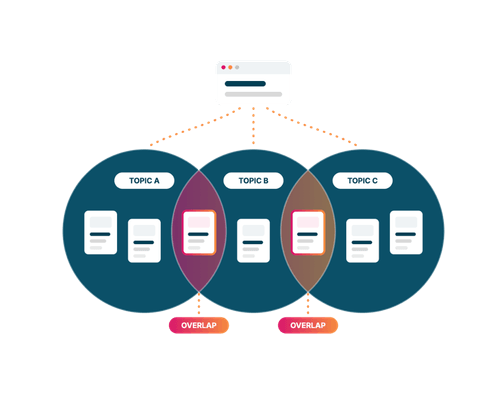
AI made publishing fast. A new service page, a blog post, a location page, each one takes minutes. What doesn't happen automatically is deciding which page should rank for which search. Without that decision, your pages end up competing with each other instead of with your competitors.
We saw this with a local service business we work with. Three of their pages were competing for one of their main services. Their homepage was competing with their own services page on six different searches. On average, both landed on page four of Google.
What it turns into:
- Keyword cannibalization, with your pages splitting clicks and link equity
- Thin pages crawled and never indexed
- Internal links pointing at whatever published most recently
- Manual consolidation later: canonical URL, redirects, re-pointing every anchor
- AI engines getting conflicting signals about which page represents you
Do this: cluster and map first, one term to one URL. Use AI to pressure-test the map and flag overlap. Whether a page should exist stays a human call.
4. Chasing AI search while skipping the fundamentals it runs on
A client asks how to get cited by ChatGPT. Their site has no schema, contradictory canonicals, and three pages fighting over their main service term.
What it turns into:
Do this: sequence it. Technical SEO, architecture, schema, and authority first. AEO tooling earns its place after.
Not sure which of your pages are competing with each other? We'll map it for you.
5. Building custom because AI made it look easy
AI lowered the cost of building. Not of maintaining, documenting, securing, or handing off. So companies build custom CRMs and DIY sites that duplicate what their platform already does.
We saw a smaller version of this with one of our clients. Their resource section was built on a separate platform, outside their main website. Three of those pages ended up competing with their own site for the same products. Two of them were stuck on page nine of Google, while the main site already had pages covering those products.
What it turns into:
- No redirect plan from old URLs, so rankings drop at launch
- Forms that don't map to CRM properties, quietly breaking reporting
- A codebase nobody can update and no vendor to call
- One person who understands it, and real exposure the day they leave
Do this: check the native capability first. Build only what the platform can't do, assign an owner, and price in maintenance.
6. Automating a process that was already broken
MQL means five different things to five different people. Then someone adds scoring and routing on top.
What it turns into:
- More bad handoffs per week, not fewer
- Sales working around the CRM instead of in it
- Reporting that looks precise and measures nothing
- A cleanup that grows every day the automation runs
Do this: fix it manually first. Definitions, data hygiene, routing rules, named owners. Then automate. A multiplier applied to a negative number gets worse.
7. Running analysis on data that was never connected
Someone asks AI for a website audit and gets one. Traffic figures, top pages, prioritized fixes. GA4 was never installed. The numbers are invented.
What it turns into:
%20(1).png?width=500&height=400&name=HubSpot%20-%20Our%20Work%20Graphics%20-%20Vested%20(500x400)%20(1).png)
Do this: confirm the connection and spot-check two or three figures before you trust anything. AI can't tell you when it's working from nothing.
Automation on top of messy data just makes the mess faster. Find out what's actually connected before you scale it.
8. Asking AI about your business without giving it your business
AI will confidently recommend a HubSpot feature the account tier doesn't include or the theme doesn't support. A developer spends a day proving it can't be done.
What it turns into:
- Pricing answers assembled from competitor pages
- Capabilities described that you don't offer
- Work scoped and estimated that isn't buildable
- Client-facing answers given with no source behind them
Do this: build a source of truth someone owns and keeps current. Verify platform advice against documentation and the actual account before scoping.
9. Publishing before a human who knows the subject reads it
The most common catch is a statistic with a citation that leads to a 404 or a study that doesn't say what the post claims.
What it turns into:

Do this: name a human owner for accuracy and voice. AI can check links and flag unsupported claims to speed that pass up. It can't tell you whether something sounds like you.
10. Adopting AI tools faster than you write rules for them
Someone pastes a client list into a free tool to fix the formatting. No rule was broken, because no rule existed.
What it turns into:
- Client data in unvetted tools, retained on terms nobody read
- Confidentiality and DPA obligations breached unknowingly
- Proprietary material used as training data on consumer accounts
- No record of what was shared or where it went
Do this: decide what data can be shared, which tools are approved, and who's accountable. Then tell people. Most of this comes from not knowing.
These are the same problem ten times
Publishing without architecture. Automating before cleanup. Reporting on data you never connected. Building what your platform already does.
None of these are AI failures. They're strategy gaps that stayed hidden because execution was slow enough to hide them. Slow work forced decisions. Fast work skips them.
When everyone can produce, production stops being the differentiator. What's left is knowing what should exist and why. AI can accelerate that. It can't decide it.
AI made execution easy. It made strategy the only hard thing left.

FAQs about using AI in marketing
Does Google penalize AI-generated content?
No. Google's policy targets scaled content produced primarily to manipulate rankings, regardless of who or what wrote it. The issue is whether pages are useful, original, and worth indexing. AI-assisted content with real expertise behind it is fine. Forty near-identical posts are not, whether a person or a model wrote them.
Can AI replace a marketing strategist?
It replaces execution capacity, not judgment. AI can draft, analyze, and produce at a volume no team can match. It can't decide what your business should be known for, which audience is worth pursuing, or what to stop doing. Those are the decisions every problem on this list traces back to.
How much should marketing teams use AI?
As much as you want on execution, once the decisions in front of it are made and the verification behind it is real. The teams getting value aren't using it less. They're using it after they've defined strategy, connected data, and cleaned up process.
Where should we start fixing AI marketing mistakes?
Start with the ones that compound. Data connection and process cleanup come first, because everything downstream depends on them. Content consolidation second, since cannibalization gets more expensive the longer it runs. Governance can be handled in a single afternoon and should be.
BUILT ON RELATIONSHIPS. DRIVEN BY RESULTS.
About Vested Marketing
 Vested Marketing is a HubSpot Partner agency based in Lafayette, Louisiana. At our core, we’re problem solvers: a team of engineers turned marketers who apply the same structured, data-driven approach used to design and build systems.
We provide HubSpot consulting and implementation, CRM and platform integrations, SEO and answer engine optimization (AEO), website design and development, and inbound content programs, each tied to measurable business goals across all industries.