

 Vested Marketing
How Can You Use Loop Marketing to Strengthen Content and AEO?
Discover how Loop Marketing turns AEO visibility into results with a repeatable system to improve content performance, personalization, and ROI.
|
Great content builds awareness, but a strong CRM strategy turns it into measurable revenue. By connecting content interactions to customer records, businesses gain personalization, accurate attribution, and automated follow-ups that directly impact the bottom line. Without this integration, even the best content often falls flat. |
A CRM strategy is simply your plan to use a customer relationship management (CRM) system (like HubSpot) as the central hub for all customer data and interactions. It connects marketing content, sales outreach, and service touchpoints so every team sees the full picture. When content marketing ties into this strategy, you stop broadcasting blindly and start building personalized paths that lead straight to revenue.

A strong CRM strategy turns your content from a nice-to-have awareness play into a revenue-driving machine. You get precise attribution so you know exactly which blog, ebook, or video nudged a prospect forward; real-time personalization that feels spot-on instead of generic; and automated handoffs that make sales reps' lives easier.
Without it? You're basically flying blind. You can't personalize, automate, or prove results so your team ends up guessing what's working, wasting budget on content that looks great in Google Analytics but doesn't move the needle on deals.
Picture this: A prospect reads your in-depth guide on "2026 B2B Lead Gen Trends" and spends 4+ minutes on page. With HubSpot's CRM integration, that engagement triggers lead scoring and attribution. Sales sees in their deal timeline: "This contact viewed our trends guide → downloaded the companion checklist → opened two nurture emails."
No more cold calls asking "What brought you here?" They jump straight to "I saw you dove deep into our trends guide. How is that aligning with your Q1 goals?" This context shortens sales cycles and boosts close rates because reps have the intel to tailor conversations and build trust fast.
Content marketing fails without CRM integration because you lose the ability to connect the dots. You pour effort into creating killer pieces, but without tying them to customer records, you can't tell which ones actually influence buys, or hand off warm leads to sales at the right moment.
Your sales team gets stuck chasing ghosts: "Who is this person? Have they engaged with us before?" Meanwhile, marketing wonders why their "top-performing" blog isn't generating pipeline. It's frustrating for everyone.
Example: Let’s say Sarah, a marketing manager at a mid-sized SaaS company, publishes a killer ebook on “2026 Revenue Operations Trends.” It gets 1,200 downloads, but three weeks later, the sales team is still cold-calling the same list with zero context. One rep finally connects with a hot lead who says, “I downloaded your ebook weeks ago and no one followed up?”
The rep scrambles, the lead cools off, and the deal stalls. Marketing blames sales for not closing; sales blames marketing for not qualifying. Meanwhile, that ebook actually did move the prospect forward; they just never got the personalized handoff they needed.
Without CRM integration, you’re leaving money on the table because:
With a proper CRM tying content to contact records, that same download would have: scored the lead, triggered a tailored nurture sequence, alerted sales with “Viewed ebook + opened 2 emails,” and given the rep everything they need to close faster and stronger.
That’s the difference between content that costs budget and content that closes deals.
You can integrate content marketing with a CRM strategy by designing every asset with measurable next actions in mind. Map outcomes, track behavior, automate nurturing, and give sales the insights to win.
HubSpot shines here: Use Marketing Studio to plan AI-generated campaigns that auto-sync to CRM, smart CTAs that personalize based on contact data, and workflows that alert sales when a lead hits high intent (e.g., viewed pricing page + downloaded case study).
Step-by-Step Integration Checklist:
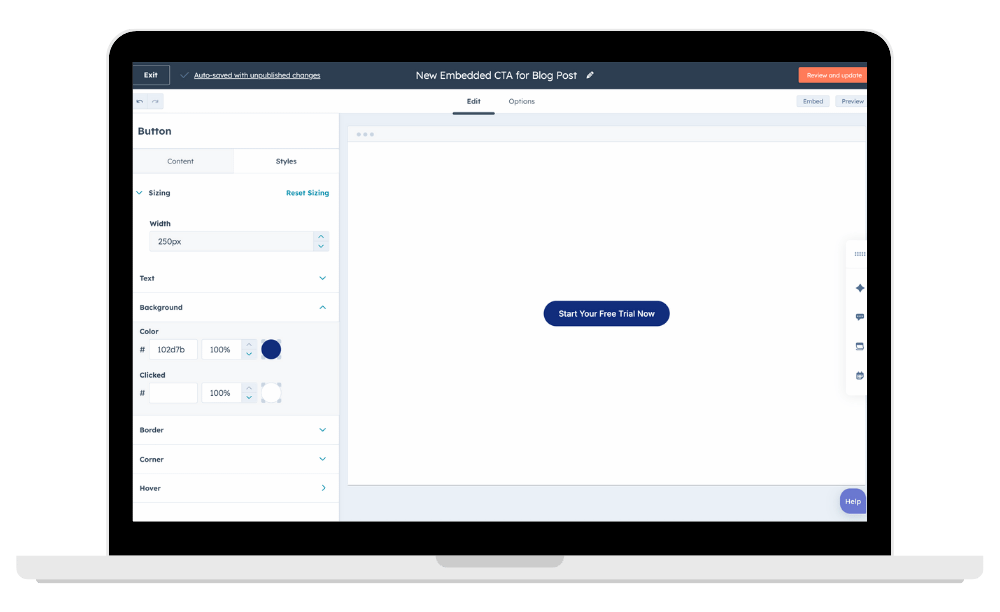
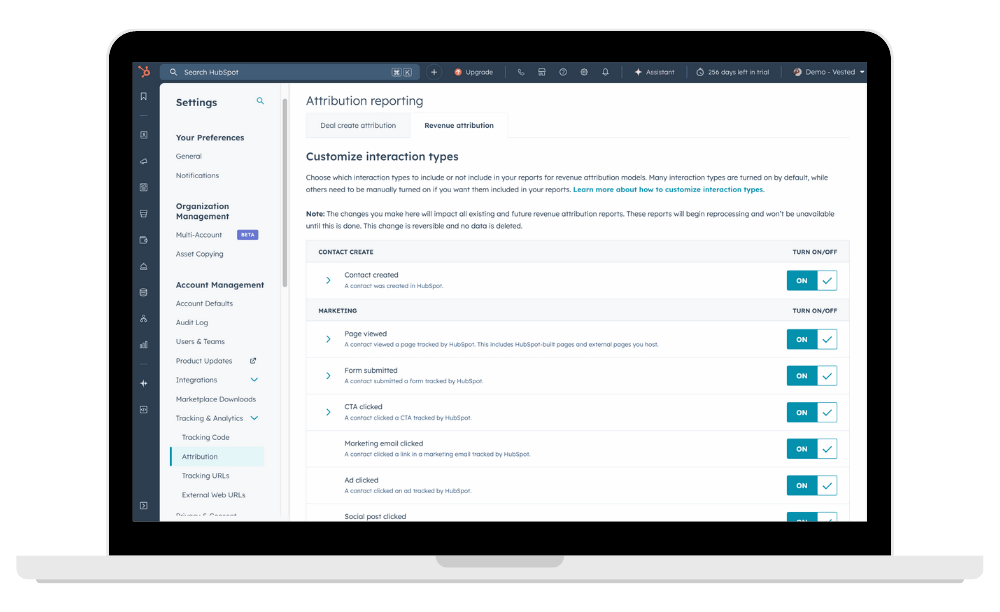
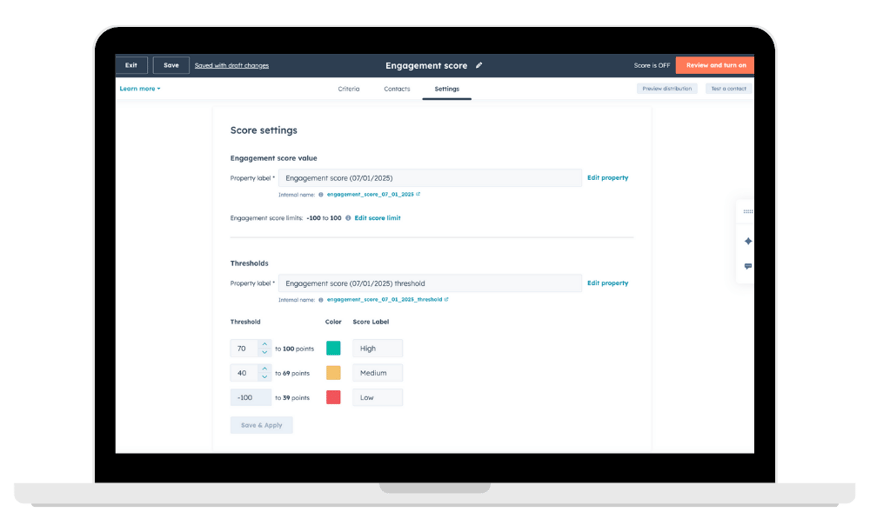
.png?width=1000&height=612&name=HubSpot%20Workflow%20Automation%20Example%20(2).png)
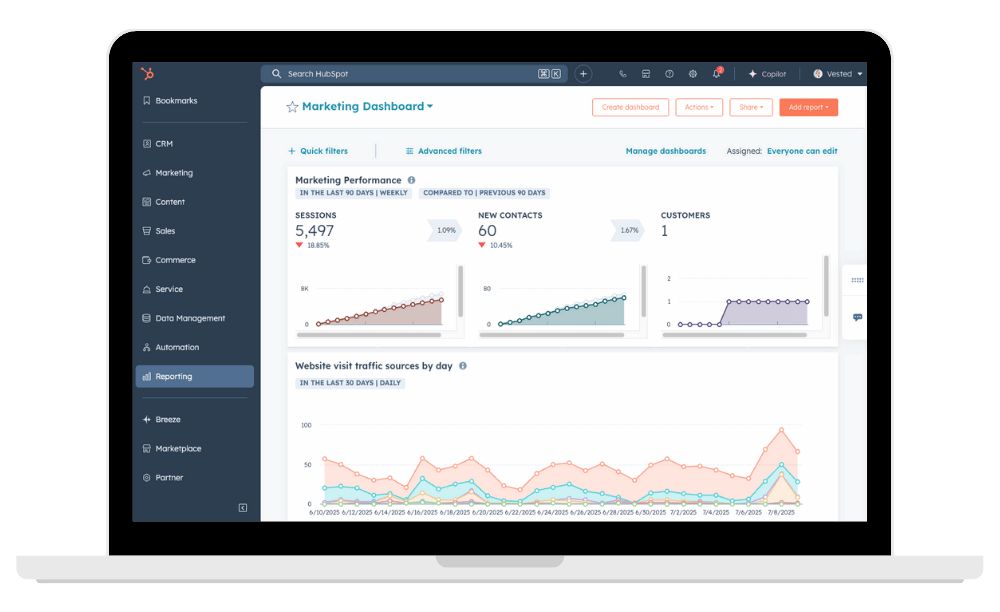
The best metrics blend visibility (reach) with value (revenue impact). Skip vanity metrics like raw pageviews and focus on what ties content to pipeline.
HubSpot's campaign analytics (now supercharged in Marketing Studio) gives you unified reporting: influenced contacts, multi-touch attribution, and revenue impact all in one dashboard. No more stitching reports together. Sales teams can now see exactly how content accelerates deals and prove ROI to leadership.
Key Metrics to Track:
Multi-touch attribution in your CRM (like HubSpot's advanced reporting) quantifies how content shortens deal velocity and hands sales the context they need to close faster.
Automation ensures timely follow-up at scale, while personalization delivers relevant experiences that are both proven to lift conversions and ROI.
Research from McKinsey shows effective personalization drives 5-15% revenue increase, with top performers seeing up to 25% lift depending on execution.
Proven Tactics:
Automation Playbook:
First-party data is the foundation of any sustainable CRM content strategy, enabling reliable personalization and attribution as third-party cookies fade. Capturing it lawfully through explicit consent and server-side tracking future-proofs your ability to segment, nurture, and prove ROI while building greater user trust.
According to Salesforce's State of Marketing report, 84% of marketers use first-party data, yet only 31% are fully satisfied with their ability to unify it across systems.
Best Practices:
Launch with quick wins, then scale. You don’t need a year-long project to start turning content into pipeline. A smart 30/60/90-day plan lets you prove quick value, build momentum, and scale without overwhelming your team. Focus on high-impact wins first, measure everything, and loop in sales early so they see the magic happening.
Think of this as your roadmap from "content chaos" to "revenue engine." Start small, celebrate lifts, and watch your sales team start asking for more of what marketing is delivering.
This phased approach is battle-tested for B2B teams: start small, prove value fast, and scale with confidence. If you're using HubSpot, tools like Marketing Studio and campaign analytics make each step smoother and more data-driven.
Integrating content marketing with a sophisticated CRM strategy isn't just smart, it's essential for turning awareness into measurable revenue in 2026 and beyond. When done right, this approach delivers attribution, personalization, and automation that directly impact your bottom line.
At Vested Marketing, we specialize in building these seamless CRM-content integrations for B2B companies ready to drive pipeline and growth. From strategy to implementation, our team helps you capture first-party signals, automate nurturing, and prove ROI with data-driven dashboards.

Sources:
McKinsey & Company. The value of getting personalization right—or wrong—is multiplying. https://www.mckinsey.com/capabilities/growth-marketing-and-sales/our-insights/the-value-of-getting-personalization-right-or-wrong-is-multiplying
Salesforce. State of Marketing Report (latest available insights as of 2026). https://www.salesforce.com/resources/research-reports/state-of-marketing
 As a certified HubSpot Partner Agency, we not only understand the benefits of using the inbound marketing platform to increase traffic and engagement, improve SEO, generate leads, design effective websites and boost sales, we know how to make it happen.
We are inbound marketing experts, SEO gurus and top-notch website developers.
Our team of Engineers Turned Marketers can help get you noticed - for a more innovative and effective way to reach customers, or provide a more seamless way for companies to find your services. Inbound Marketing has no limit to industry, serving from Crypto & NFT, mining, oil and gas, technology & automation, engineering, technology, construction, healthcare, specialty pharmacy, to industrial & manufacturing.
.png)
Discover how Loop Marketing turns AEO visibility into results with a repeatable system to improve content performance, personalization, and ROI.
-1.png)
Avoid the 7 most common CRM customization mistakes in 2026 that kill adoption and ROI. Learn simple fixes to build a lean, revenue-driving HubSpot...

Get answers to your top questions about Loop Marketing, AEO, and AI-driven inbound strategies for smarter, faster ROI.