

 Vested Marketing
Why Isn’t My Website Generating Qualified Leads Even With Traffic?
Your website has traffic but no pipeline. Learn how structure, messaging, SEO, AEO, growth-driven design, and HubSpot drive qualified leads.
|
Track fewer metrics, and make everyone connect to revenue. Start with a business outcome, map the metrics that feed it, and cut anything that doesn't change a decision. If your leadership team can't act on a number, it doesn't belong on the dashboard. |
The vanity metrics vs revenue metrics debate comes down to one question: if this number moved tomorrow, would your team do anything different?
Most marketing dashboards are stuffed with numbers that look healthy but can't answer that question. Followers climb, email opens tick up, impressions keep stacking up, and meanwhile, nobody can say whether marketing actually generated revenue this quarter.
The sections below walk through how to tell the difference between vanity versus revenue metrics, why so many teams drift toward activity metrics, and how to rebuild reporting around numbers that actually move the business forward.

Vanity metrics are numbers that measure activity but have no reliable connection to revenue, pipeline, or customer outcomes. They tend to go up when you spend more, post more, or send more and they rarely tell you whether any of that work produced a business result.
Some of the most common vanity metrics include:
These numbers aren't useless, but they're diagnostic at best. A jump in traffic might mean nothing if none of it converts. A spike in email opens might just mean your subject line was clickbait.
Here's the pattern that shows up constantly in marketing reviews. A team celebrates a 40% jump in website traffic, but the conversion rate dropped, lead volume stayed flat, and the sales team never got a single qualified opportunity out of the quarter. The traffic number isn't wrong. It's just not connected to anything that matters. The real tell: if a metric goes up and no one can describe what action to take next, it's a vanity metric. That's the "So what?" test, and it's the cleanest way to audit any existing dashboard.
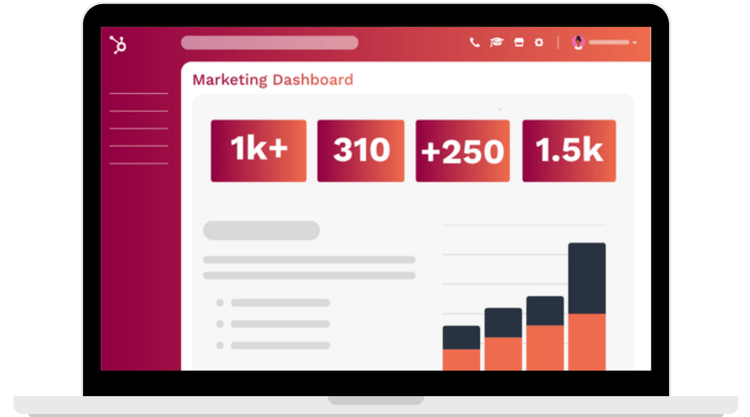
Revenue metrics are numbers that connect directly to business outcomes - pipeline generated, customers acquired, and revenue produced. They answer the question vanity metrics can't: did this marketing activity contribute to the business growing?
These are the numbers that help marketing teams make better decisions about where to invest time and budget:
These numbers force a real conversation with sales. You can't measure MQL-to-SQL conversion without agreeing on what a qualified lead actually looks like. You can't calculate marketing-attributed revenue without a working attribution model. That friction is the point: revenue metrics only work when marketing and sales are aligned on definitions, stages, and handoff criteria.
Most marketing teams default ot vantity metrics because vanity metrics are easy. That's the honest answer.
Every platform - Google Analytics, Meta Business Suite, LinkedIn Page Analytics, HubSpot's default dashboards - surfaces activity numbers first. They're pre-built, pre-charted, and require zero configuration. Revenue metrics require plumbing: CRM integration, attribution setup, and agreement between teams on stage definitions.
There are four patterns we see on repeat:
None of these patterns indicates a bad marketing team. They indicate a measurement system that wasn't designed with revenue in mind. Fixing it isn't about working harder on reporting - it's about rebuilding the reporting structure from the business outcome backward.
Use this table as a gut-check when auditing an existing dashboard. For every vanity metric you're reporting on, there's a revenue-linked counterpart that measures the same underlying question with more honesty.
| Vanity metric | Revenue metric that actually matters | What it really tells you |
|---|---|---|
| Page views | Conversion rate from visitor to lead | Whether traffic is actually moving toward an action that matters. |
| Followers gained | Leads generated from social channels | Whether audience growth is producing pipeline or just noise. |
| Email open rate | Email click-to-conversion rate | Whether email content drives a measurable next step, not just a preloaded image. |
| Ad impressions | Cost per acquisition (CPA) | Whether paid spend is producing customers, not just reach. |
| Time on site | Form completions and booked calls | Whether content engagement translates into commercial intent. |
| Total lead volume | MQL-to-SQL conversion rate | Whether the number of leads reflects actual quality and sales readiness. |
None of the vanity metrics in this table are worthless. Each one has diagnostic value when paired with the right revenue metric. The problem starts when the left column is the whole dashboard and the right column is missing.
You shift from vanity metrics to revenue metrics by starting with the revenue number and working backward from there.
This sounds obvious, but most marketing teams build reports in the opposite direction - they start with what their tools display and try to connect it to business outcomes after the fact. The shift works when the order is reversed.
Here's the sequence that works:
The Loop Marketing framework (Express, Tailor, Amplify, Evolve) puts this review cycle at the center of marketing execution. The Evolve phase is where reporting translates into strategic change. Without a built-in evaluation loop, even good metrics sit in dashboards without ever driving decisions.
The difference between vanity metrics vs revenue metrics isn't just a reporting question. It shapes where the budget goes next quarter. It shapes which campaigns get expanded and which get cut. It shapes whether marketing and sales are speaking the same language or running on parallel tracks.
When a team measures the wrong things, they optimize for the wrong things. Ad budget shifts toward impressions instead of conversions. Content production prioritizes traffic instead of commercial intent. Social strategy chases followers instead of qualified prospects. Every downstream decision inherits the distortion of the upstream measurement system. The good news: fixing this is easier than it used to be. As HubSpot keeps updating its platform, connecting marketing activity to real revenue gets simpler, with no more hand-stitched reports.
Fixing the measurement layer fixes a cascade of operational problems. Budget allocation gets sharper. Sales and marketing alignment improves because there's a shared scoreboard. Leadership gets reports they can actually make decisions from. And marketing starts showing up in revenue conversations as a contributor instead of a cost center.
The same trap shows up across industries. Commercial recycling facilities can report on tonnage processed and pickups completed, but revenue per ton and contract renewal rates are what tell leadership whether the facility is profitable. VoIP providers can chart total call volume and uptime, but first-call resolution, customer satisfaction, and MRR churn are what show whether customers are actually sticking around.
Activity metrics describe what happened. Revenue metrics describe whether it mattered.
Book a free consultation with Vested. We'll audit your current metrics and map a reporting structure that connects every campaign to business outcomes - grounded in our Loop Marketing framework.

 As a certified HubSpot Partner Agency, we not only understand the benefits of using the inbound marketing platform to increase traffic and engagement, improve SEO, generate leads, design effective websites and boost sales, we know how to make it happen.
We are inbound marketing experts, SEO gurus and top-notch website developers.
Our team of Engineers Turned Marketers can help get you noticed - for a more innovative and effective way to reach customers, or provide a more seamless way for companies to find your services. Inbound Marketing has no limit to industry, serving from Crypto & NFT, mining, oil and gas, technology & automation, engineering, technology, construction, food and beverage, healthcare, specialty pharmacy, to industrial & manufacturing.
Moz - Analytics and reporting insights https://moz.com/blog
McKinsey & Company - Growth, Marketing & Sales research https://www.mckinsey.com/capabilities/growth-marketing-and-sales
%20(1).png)
Your website has traffic but no pipeline. Learn how structure, messaging, SEO, AEO, growth-driven design, and HubSpot drive qualified leads.
%20(1).png)
Why B2B marketing data doesn't match sales revenue data. Learn the structural causes and how to fix CRM, attribution, and pipeline misalignment in...

Not sure if HubSpot is helping or hurting your growth? Learn the clear signs your HubSpot portal is misaligned and how to fix it before scale breaks...